
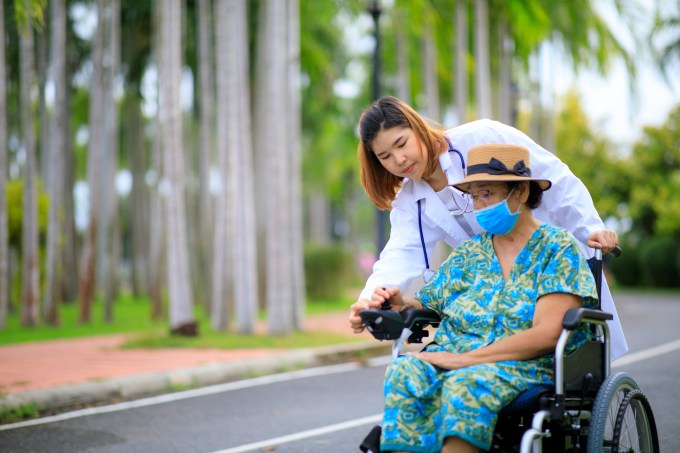
It’s the perfect storm. You’re living a normal life with contentment and then stroke happens. You’re overcome with fear and tears and then optimism and hope. The stroke victim survives the ordeal and the family is overcome with thankfulness. Prayers of praise go up to God and happiness returns. Then the hard work begins for the stroke survivor and the caregiver.
The stroke survivor must begin rehabilitation in the forms of physical, speech, and occupational therapies, and other rehabilitation. Most often, rehab begins in the hospital and then the stroke survivor is moved to a rehabilitation center. This happened with both Gina and Albert. Gina is my friend Rob’s wife. Rob and I worked at a public high school as assistant principals when Gina had a massive stroke. Neither she nor Albert, my husband, exhibited the standard signs of stroke that would cause either Rob or I to suspect a stroke would occur in our spouses.
Gina didn’t sleep well the night before her stroke and she had a headache and stomach ache. Albert was working late at night at his mom’s house when his stroke happened. He didn’t complain verbally to anyone that he was in pain so there’s no record of the type of pain that he had or if he was in pain.
Both Gina and Albert had brain bleeds that caused a large amount of damage to their brains, causing them to lose the ability to use one side of their body. Gina’s stroke was on the right side of her brain and she lost the ability to use the left arm, hand, and leg, and she couldn’t swallow on her own. Albert’s stroke was on the left side of his brain and he lost the ability to use his right arm and hand and is considered right side weak, though he can walk on his own. Albert also had difficulty swallowing. After months of speech therapy, both were able to pass their swallow test and were able to eat solid foods and drink liquids without thickeners.
After months of physical therapy, Albert was able to walk on his own with a cane, but it’s obvious that there is an impairment in his legs when he walks. Gina did not regain her ability to walk on her own. Rob bought her a motorized wheelchair to help her get around on her own. This gave her a little more independence, but she still struggled.
Neither Gina nor Albert regained use of their arms or hands.
One of Gina’s hardest nights was when her physicians injected the spinal block with baclofen into different parts of her spine to see if her pain would lessen. The relief from the baclofen only lasted 24 hours, but they were 24 hours without pain, which was glorious. After the 24 hours were over, the pain returned with more intensity than ever. Gina learned that she could only have the injection every two weeks, which she did. After each injection, she knew that within 24 hours the pain would return, but the relief was worth it.
One of my hardest moments with Albert was when we learned that he had expressive aphasia and what it meant for us going forward. We were still in the hospital and Albert was trying to answer a question or trying to explain something to me. His responses were, “One day at a time”, “Main menu”, “I need a break”, or “I need to chill. I didn’t understand why he was saying these words so I asked him to repeat his answers. Albert said the same words over and over and over again. For several years these words were his responses to every question that he was asked and the words that he used when he asked questions. This is how aphasia expresses itself in Albert.
Both Rob and I thought that we would get to a point where Gina and Albert would recover fully and regain their independence, but it hasn’t happened.


 Learning to Live Life and Loving it - Carol Johnson Blogs